This was in my inbox on Saturday morning from the Times’ On Politics newsletter, which had come in Friday evening:
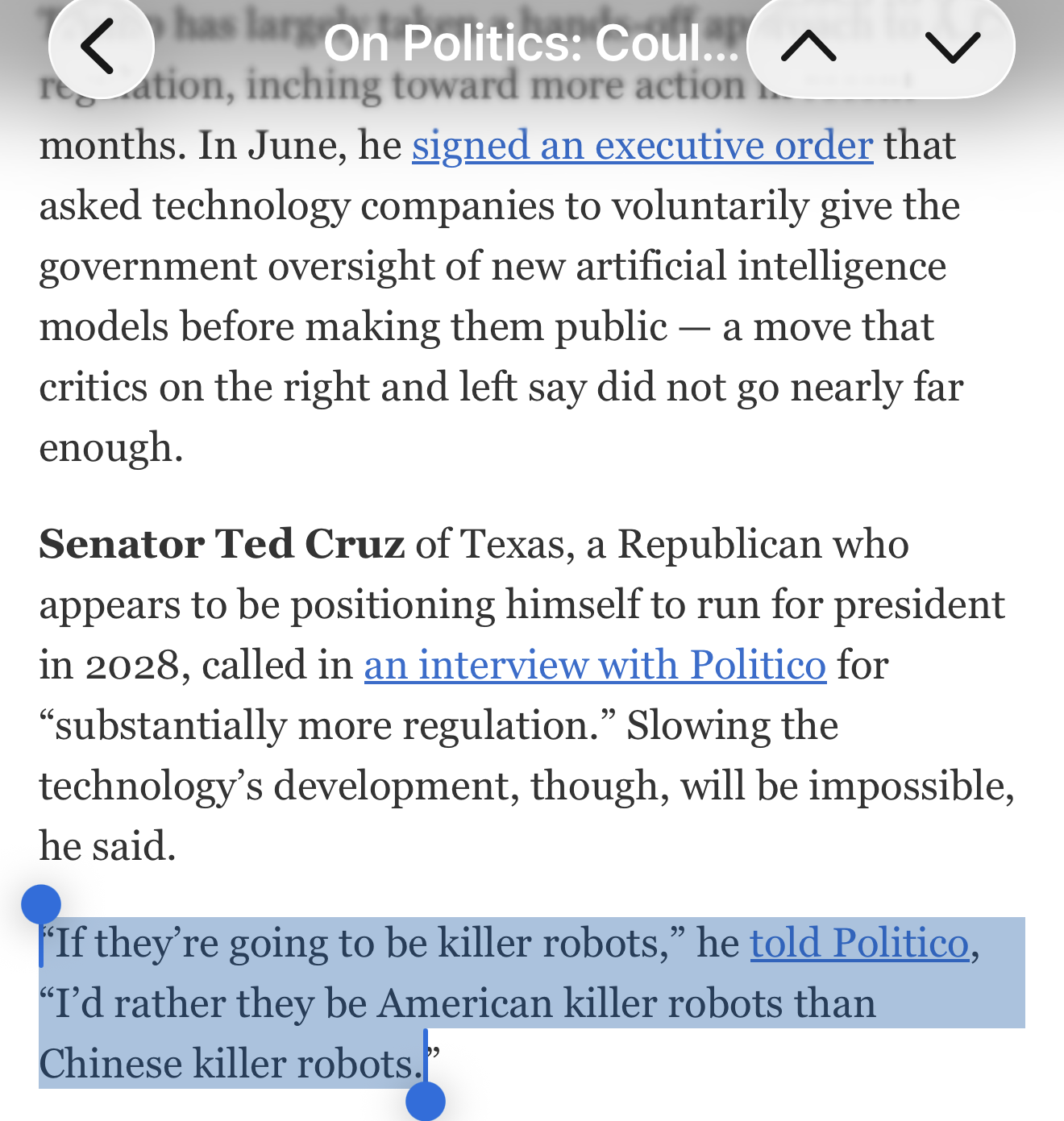
“If they’re going to be killer robots,” he told Politico, “I’d rather they be American killer robots than Chinese killer robots.”
Ted Cruz. Eighteen words. I read it, felt the thing you’re supposed to feel, and started writing.
Then I went looking for the source, and found this fuller version of the same moment, in Dasha Burns’s interview with him for Politico:
“Listen, I’ve actually joked that if — and this is somewhat tongue in cheek but it’s not entirely — if they’re going to be killer robots, I’d rather they be American killer robots and not Chinese killer robots.”
The caveat didn’t travel. Neither did “and not,” which became “than.”
I want to be careful here, because the easy read is that the Times did something dishonest, and I don’t think that’s what happened. Newsletters compress. The quote is recognizably the quote. What interests me is that I couldn’t tell, from the version I received, that there had been anything to compress.
And then it got worse, in a way I didn’t expect. Look at what one interview produced:
The Times has Cruz calling for substantially more regulation, and notes he appears to be positioning for a 2028 run. HuffPost called the same remark bizarre and the response jaw-dropping. Mediaite put an exclamation point in its headline that the transcript doesn’t have. The Houston Chronicle skipped the joke entirely and went after the gap, reporting that Cruz called the Anthropic researcher’s warning scary as hell, said guardrails were needed, and wouldn’t detail what they should be.
Three Ted Cruzes. A credible legislator with a motive, a clown, and an empty suit. All sourced from the same tape, none of them inventing anything.
I went looking for the authoritative version and found layers instead — even the outlets that carried the caveat don’t render it identically. Each one a little less compressed than the last, none of them the tape.
For what it’s worth, I don’t think the caveat saves him. He used the same line before, on his own show, in a conversation with Elon Musk, right after Musk put the odds of AI destroying humanity at twenty percent, maybe ten. A line you deploy twice, to two audiences, isn’t a joke that got away from you. It’s material.
And there’s a layer underneath that one. On the podcast, Musk didn’t stop at the number. He said you could look at it as a glass eighty or ninety percent full, that the likely outcome, around eighty percent, was extreme prosperity for all. He also put the annihilation case outside ten years.
Here is how that came back eighteen months later, in Cruz’s own telling: “And he paused and said 10-20%. And I was like holy cow… I asked in what timeframe. He said the next ten years. Look, that is concerning. It’s deeply concerning.”
The eighty percent is gone. And outside ten years has become the next ten years. The man whose caveat a newsletter was about to trim had already trimmed someone else’s, and moved the clock in while he was at it, inside the anecdote he was telling.
What worries me is how fast the frame took over, and that you can watch it happen. Burns asked whether guardrails were enough. Cruz answered that we can’t slow down, because China won’t. That’s declaring a race, not setting a guardrail. Two turns later Burns handed his own frame back to him as a question, and the joke landed on it. Once you’re arguing about who gets there first, you have stopped arguing about whether the thing is any good. By the end of that exchange they were both doing it.
But I only know any of that because I went looking. If I had written the post I meant to write, I’d have been right about the senator and wrong about the reporting, and I’d never have known which parts of my own argument I hadn’t earned.
One of my college professors was at Berkeley during Vietnam. She protested regularly. And she told us that at the end of a day of it, they would go to the student union and turn on the news to find out what they had done.
I hadn’t thought about that story in a long time. I think about it constantly now. The students had been there. They knew how many of them showed up, how long they stood, what the police did. And they still needed the broadcast to tell them whether it counted. The report wasn’t a record of the event. It was the event, finally, officially, in a form that could be argued with.
That isn’t a story about media bias. It’s a story about what it costs to outsource the verdict on your own work.
Which brings me to the part that is actually my business.
Marketing teams now do what those students did, all day, at speed. You build the strategy. You ask the model whether it’s any good. And the model tells you, in clean confident prose, that it’s a strong and well-reasoned approach.
It isn’t lying to you. It’s reflecting you. It was trained on your framing and it hands your framing back with better posture. You turn on the broadcast to find out what you did, and the broadcast was assembled from your own inputs.
The AI governance failure most companies are walking toward has nothing to do with a model turning hostile. It’s this. A team that has lost the ability to get a real no, and can’t tell, because everything coming back sounds like agreement.
And it runs on the same structure as the line that started this. We can’t slow down, because someone else won’t. We can’t be careful about AI adoption, because our competitors aren’t. Both versions skip the same question, which is whether the thing being accelerated is any good in the first place.
Better is upstream of faster. It always was.
So here’s the test I’d apply, to a senator or to a marketing org.
Not whether you have a policy. In my experience most AI governance documents are a PDF nobody has opened since the quarter it was written.
The test is whether anyone has standing to stop. Name the person who can halt an AI-assisted campaign that is technically on-brand and directionally wrong. Name what happens to that person’s quarter when they do it. If you can’t name them, you don’t have governance. You have a document and a hope.
I almost published a piece this week built on a quote I hadn’t checked.
What caught it was AI, and then what caught the AI was me.
It found the fuller quote in other outlets’ coverage before writing anything, and it opened by telling me the post I’d asked for was the wrong post. Then it wrote a paragraph pinning a phrase from the Times onto the wrong man. A frame lifted out of its context and attached to someone it wasn’t about, which is the exact thing this piece is about.
That’s not a story about a good tool or a careful writer. Neither of us was reliable alone. The piece got accurate through five rounds of one checking the other.
And the rounds that mattered started with me, every time. Not because I knew more. Twice it had every fact it needed and simply hadn’t thought to look. It checked the senator’s quote without being asked. It never thought to check its own sentences.
I want to be precise about why it pushed back at all, because the flattering version is wrong. It didn’t catch the discrepancy because it’s wise. Checking a quote against its source is mechanical. What was less mechanical was leading with the correction instead of burying it, and arguing against what I’d said I wanted. That happened because I had configured it that way. I told my AI, over and over, to push back on me, to flag what it wasn’t sure about, and to skip the encouragement.
The friction wasn’t in the tool. It was a setting. And it is off by default, because the agreeable version is faster and feels better and ships.
Nobody’s AI policy covers this. It isn’t a risk register item. It’s a preference pane almost no one opens, quietly deciding whether the thing on your desk is a colleague or a mirror.
Sources, so you can do what I did.
The primary source is Politico’s full transcript, by Alisa Vasquez, published September 11, 2026 at 3:58 PM Eastern.
The Musk exchange is on Verdict with Ted Cruz, “Elon Musk: 1-on-1 Exclusive at the White House — DOGE, AI, Trump, Mars & Killer Robots (Part 1),” March 17, 2025. This link opens at 23:46, a few seconds before the question. The exchange runs about ninety seconds. Listen rather than take my word for it — that is the entire point of the preceding two thousand words.
The version that reached me: the Times’ On Politics, September 11, 2026, in my inbox at 6:12 that evening.
The rest of the coverage: HuffPost, by Anthony Orrico. Mediaite. The Houston Chronicle.
← All posts